publications
publications by categories in reversed chronological order. generated by jekyll-scholar.
2024
- ICML
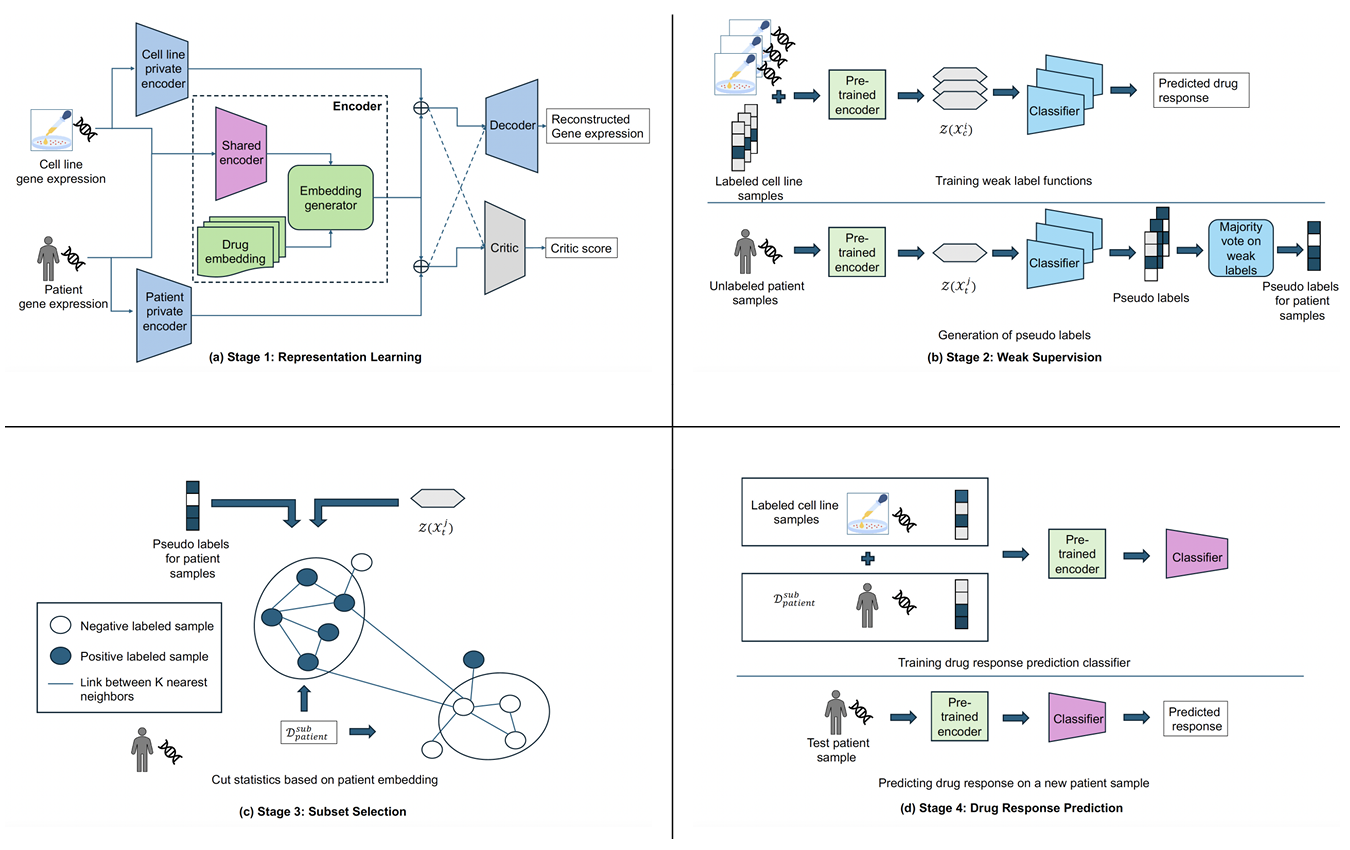 WISER: Weak supervISion and supErvised Representation learning to improve drug response prediction in cancerKumar Shubham, Aishwarya Jayagopal, Syed Mohammed Danish, and 2 more authorsIn International Conference on Machine Learning (ICML), 2024
Cancer, a leading cause of death globally, occurs due to genomic changes and manifests heterogeneously across patients. To advance research on personalized treatment strategies, the effectiveness of various drugs on cells derived from cancers (‘cell lines’) is experimentally determined in laboratory settings. Nevertheless, variations in the distribution of genomic data and drug responses between cell lines and humans arise due to biological and environmental differences. Moreover, while genomic profiles of many cancer patients are readily available, the scarcity of corresponding drug response data limits the ability to train machine learning models that can predict drug response in patients effectively. Recent cancer drug response prediction methods have largely followed the paradigm of unsupervised domain-invariant representation learning followed by a downstream drug response classification step. Introducing supervision in both stages is challenging due to heterogeneous patient response to drugs and limited drug response data. This paper addresses these challenges through a novel representation learning method in the first phase and weak supervision in the second. Experimental results on real patient data demonstrate the efficacy of our method (WISER) over state-of-the-art alternatives on predicting personalized drug response.
@inproceedings{shubham2024wiserweaksupervisionsupervised, title = {WISER: Weak supervISion and supErvised Representation learning to improve drug response prediction in cancer}, author = {Shubham, Kumar and Jayagopal, Aishwarya and Danish, Syed Mohammed and AP, Prathosh and Rajan, Vaibhav}, booktitle = {International Conference on Machine Learning (ICML)}, year = {2024}, url = {https://arxiv.org/abs/2405.04078}, } - IEEE TNSEA Unified α−η−κ−μ Fading Model Based Real-Time Localization on IoT Edge DevicesAditya Singh, Syed Danish, Gaurav Prasad, and 1 more authorIEEE Transactions on Network Science and Engineering, 2024
Wi-Fi-based localization using Received Signal Strength (RSS) is widely adopted due to its cost-effectiveness and ubiquity. However, localization accuracy of RSS-based localization degrades due to random fluctuations from shadowing and multipath fading effects. Existing fading distributions like Rayleigh, κ−μ , and α-KMS struggle to capture all factors contributing to fading. In contrast, the α−η−κ−μ distribution offers the most generalized coverage of fading in literature. However, as fading distributions become more generalized, their computational demands also increases. This results in a trade-off between localization accuracy and complexity, which is undesirable for real-time localization. In this work, we propose a novel localization strategy utilizing the α−η−κ−μ distribution combined with a novel approximation method that significantly reduces computational overhead while maintaining accuracy. Our proposed strategy effectively mitigates the trade-off between localization accuracy and complexity, outperforming existing state-of-the-art (SOTA) localization techniques on simulated and real-world testbeds. The proposed strategy achieves accurate localization with a speedup of 280 times over non-approximated methods. We validate its feasibility for real-time tasks on low-compute edge device Raspberry Pi Zero W, where it demonstrates fast and accurate localization, making it suitable for real-time edge applications.
@article{10713179,
  author = {Singh, Aditya and Danish, Syed and Prasad, Gaurav and Kumar, Sudhir},
  journal = {IEEE Transactions on Network Science and Engineering},
  title = {A Unified α−η−κ−μ Fading Model Based Real-Time Localization on IoT Edge Devices},
  year = {2024},
  volume = {11},
  number = {6},
  pages = {6207-6218},
  keywords = {Location awareness;Accuracy;Real-time systems;Rayleigh channels;Computational modeling;Maximum likelihood estimation;Fingerprint recognition;Fluctuations;Wireless fidelity;Smart devices;Edge computing;fading;IoT;localization},
  url = {https://ieeexplore.ieee.org/abstract/document/10713179},
}
